


Hardwood Floor Species Guide
Posted by Ben Garelick (@BlueShirtBenny) on 6th Oct 2026
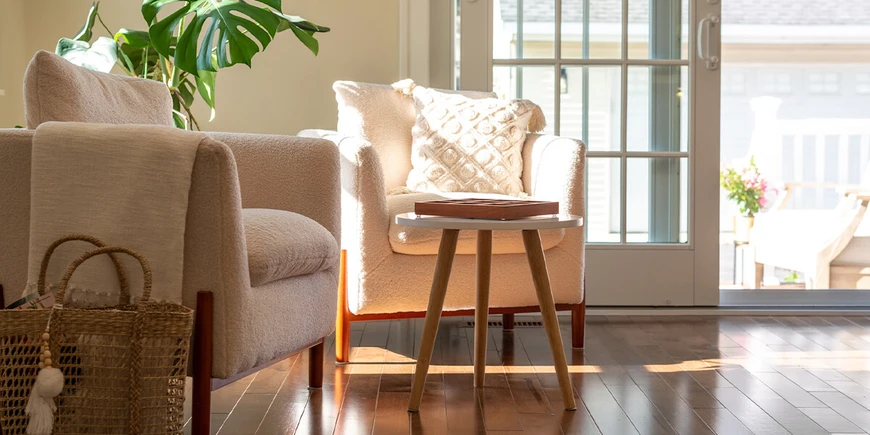
Once you decide you want hardwood floors in your home, it's easy to picture them in your kitchen or living room for the next few decades. Then you start comparing species and discover just how many options are available. From oak and hickory to cherry and maple, there are many species of hardwood you can choose for your floors.
Hardwood floors are a long-term investment, which is why it's important to choose well. A trustworthy wood floor species guide gives you a practical way to compare your options, from hardness and color to grain pattern and everyday durability. With clear information and expert advice, you can narrow your choices and feel more confident before you visit a showroom.
Key Takeaways
- The Janka hardness scale tells you how well a species resists dents and everyday wear, making it your best starting point for comparison.
- Each species of hardwood can vary in its hardness, appearance, durability and grain pattern.
- For many Mid-Atlantic homes, white oak offers a strong balance of hardness, style versatility and moisture resistance.
- The right species depends on your household, foot traffic and local humidity, not just the color or grain pattern you're drawn to.
How to Choose the Right Hardwood Floor Species
Choosing the right hardwood floor species comes down to three interconnected factors — hardness, appearance and how well a species fits your lifestyle.
Understanding the Janka Hardness Scale
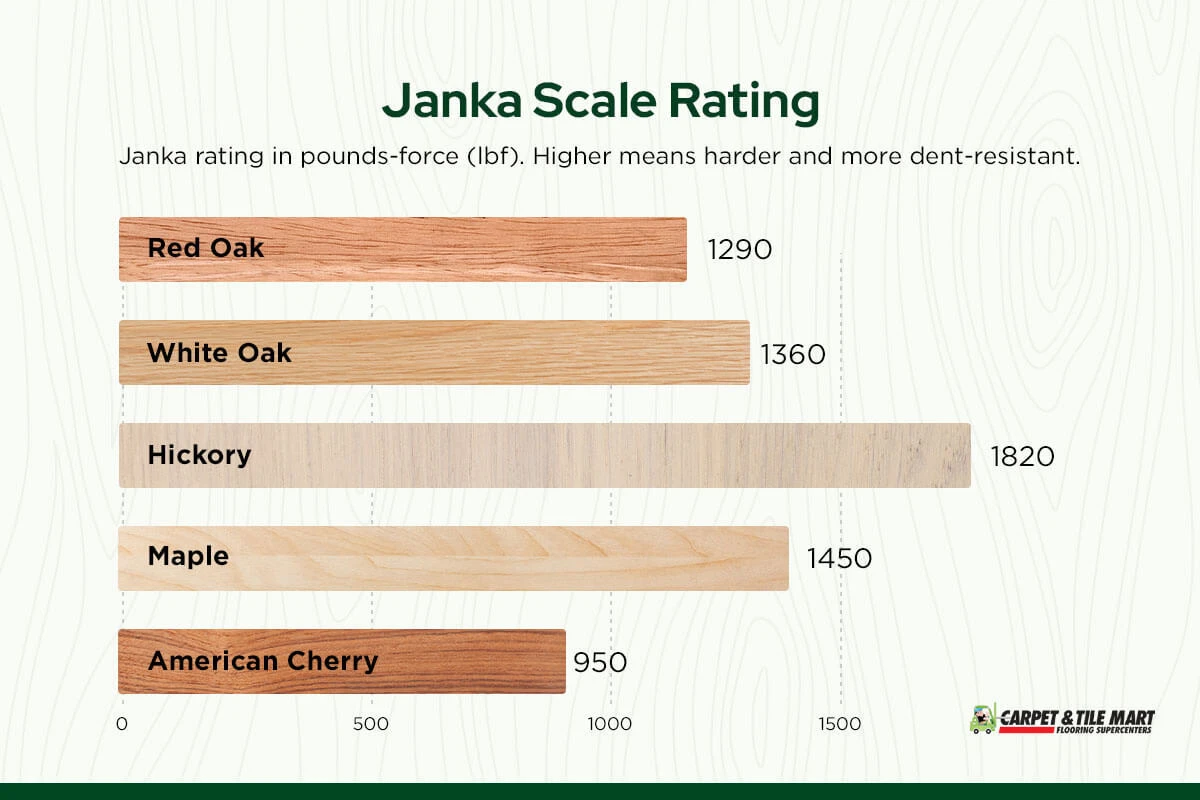
The Janka Scale measures the force, in pound-force, required to push a steel ball with a diameter of 0.444 inches halfway into a piece of wood. In practice, a higher rating indicates a floor that resists dents and everyday wear better than a lower-rated species.
When you're weighing options with a Janka hardness scale flooring chart in hand, look for a rating that fits your household's expected activity level and long-term flooring goals.
The industry traditionally uses Northern Red Oak as its benchmark, and every other species gets measured against it.
Keep in mind that for solid wood floors, the Janka scale provides a useful baseline for comparing species hardness, but engineered wood flooring has its own product-specific performance factors. Hardness isn't the whole story either. How a plank is cut and how the finish is applied also affect how well a floor holds up day to day.
| Hardwood Species | Janka Scale Rating (LBF) |
|---|---|
| Red Oak | 1,290 |
| White Oak | 1,360 |
| Hickory | 1,820 |
| Maple | 1,450 |
| American Cherry | 950 |
How Grain Pattern and Color Shape Your Space
Grain pattern doesn't just affect your floor's appearance. It also influences how much natural variation you see. Open-grain species have more texture and variation, while tight-grain woods like maple create a smoother, more uniform look.
Color plays its own role in how a room feels. Light tones tend to open up a space, making a small kitchen or hallway feel larger and brighter, while darker woods bring warmth and a more dramatic, cozy feel to living rooms and dining rooms. There's no right or wrong answer. Your best choice depends on the mood you want to create.
Finally, it's worth considering how UV light will affect your hardwood floors. Some hardwood species slowly deepen and darken if exposed to UV light, creating a floor whose appearance evolves over time. This natural color change can add character over time, so it’s worth deciding whether you prefer a consistent look or a floor that gradually deepens with age.
Matching Species to Your Lifestyle
Your lifestyle matters just as much as your design preferences when narrowing down a species. The main lifestyle factors to consider include:
- Pets and kids: Households with pets and children often benefit from a harder, more dent-resistant species that supports active everyday living.
- Traffic patterns: High-traffic hallways and living rooms benefit from harder wood species, while formal dining rooms or low-traffic bedrooms can prioritize appearance and style over sheer durability.
- Humidity swings: Seasonal humidity often varies in homes across the Mid-Atlantic. Those swings affect how much a wood species expands, contracts and stays dimensionally stable over time.
Types of Hardwood Floors and Wood Species
Each species of hardwood has its own unique characteristics. For Mid-Atlantic homeowners, the best species choice depends on how the floor will perform through seasonal humidity changes, daily foot traffic and the installation conditions in your specific home.
Red Oak
Red oak is a reliable classic, prized for its wide availability, versatility and timeless look. With a Janka rating of 1,290, it's the industry benchmark against which every other species is measured, providing a hardness level that has proven itself in countless American homes for generations.
Visually, red oak brings a warm, pinkish tone paired with a pronounced, open grain that adds texture and movement to a room without overwhelming it. That combination makes it easy to pair with a wide range of furniture styles and color palettes, from traditional to transitional.
Because it's produced domestically and in high volume, red oak is also one of the more budget-friendly hardwood options on the market while still offering durability and timeless good looks. If you're drawn to traditional interiors, or you simply want a dependable, well-priced floor that will still look great decades from now, red oak is the reasonable, tried-and-true choice.
White Oak
When people compare red oak versus white oak flooring, it's usually because the two share so much in common. Both offer excellent availability, versatility and a classic hardwood look that works in almost any home.
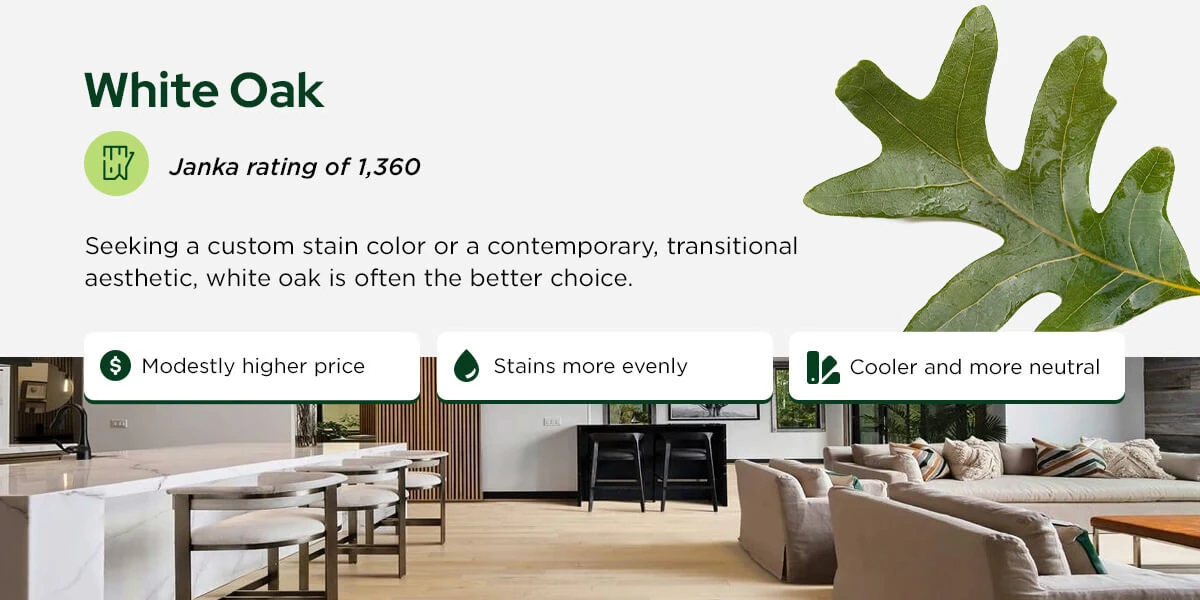
Where they differ is in the details. White oak has a slightly higher Janka rating of 1,360 and typically comes at a modestly higher price point than red oak. Its color leans cooler and more neutral, without the pinkish undertones you'll find in red oak.
White oak's grain also runs tighter, which means it takes stain more evenly and delivers a cleaner, more uniform finished look. Thanks to natural tannins in the wood, it holds up slightly better against moisture as well.
For homeowners seeking a custom stain color or a contemporary, transitional aesthetic, white oak is often the better choice.
Hickory
If your household includes dogs, kids or simply heavy daily foot traffic, hickory deserves consideration. It's one of the toughest domestic species, and if you compare hickory versus oak flooring, hickory consistently wins on durability.
Hickory's grain pattern is bold and dramatic, swinging from pale white sapwood to rich, deep brown heartwood, sometimes within the same plank. That dramatic range makes it a natural fit for rustic or farmhouse-style homes, as well as for spaces where the floor is meant to be a standout design feature.
Because hickory has strong natural variation, stains can highlight different tones across each plank. The result is a bolder, character-rich floor that pairs especially well with furniture and finishes chosen to complement its movement and color variation.
Maple
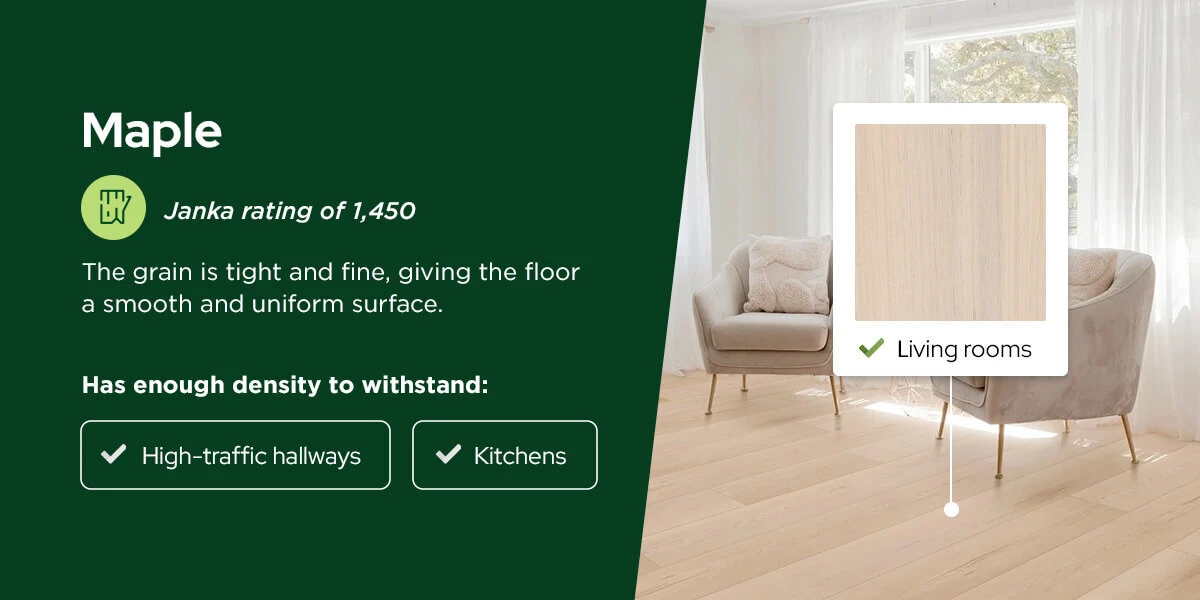
With a Janka rating of 1,450, maple starts strong in hardness and has enough density to withstand high-traffic hallways, kitchens and living rooms. In an oak versus maple flooring comparison, the two are fairly close in durability, though maple pulls slightly ahead in overall hardness.
Where maple really sets itself apart is its look. The grain is tight and fine, giving the floor a smooth, uniform surface, and its color ranges from creamy white to light tan. That clean, understated palette makes maple a favorite for contemporary and modern interiors, as well as kitchens that want a floor that stays in the background rather than stealing attention.
Maple's tight grain gives it a smooth, consistent appearance, so samples are often a strong indicator of how the flooring will look in your home. If you love a clean, uniform style, maple can be a beautiful fit, especially with a finish that supports your household’s activity level.
American Cherry
American cherry brings a distinctive, elegant look to a room with a light pinkish-red tone that deepens noticeably with age and sunlight exposure.
Cherry's Janka rating of 950 is softer than oak, maple or hickory, making it best suited for spaces with lighter daily activity. It can be a beautiful option for formal dining rooms, primary bedrooms and other areas where its rich color and elegant character can shine.
It's worth noting that American cherry, sometimes called black cherry, is a domestic species and distinctly different from Brazilian cherry. Brazilian cherry carries a much higher Janka rating and a noticeably darker color overall, though its color range spans a wider spectrum than American cherry's more consistent tone.
Exotic Hardwood Species
Exotic hardwood flooring species are sourced from outside of North America. Typically from tropical regions, they tend to run harder and bolder than domestic options, with dramatic grain patterns and striking color variation. If you're chasing the hardest wood for flooring on the market, exotics are often where you'll land.
Additionally, if you want a statement floor that can also hold up to heavy use, exotic hardwood flooring is often a great option. Some of the most popular choices include:
- Brazilian cherry: Also called Jatoba, it carries a Janka rating of 2,350 to 3,290, making it significantly harder than many domestic hardwood species.
- Tigerwood: Native to Central and South America, tigerwood features reddish-brown coloring with dark streaks across its grain and rates 2,170 on the Janka scale.
- Acacia: With a Janka rating of 1,430, acacia stands out because no two planks share the same grain pattern, giving every floor a unique appearance.
- Brazilian oak: Brazilian oak, also known as Tauari, closely resembles North American oak, making it a familiar-looking option among exotic hardwoods.
- Bamboo: Technically a grass rather than a hardwood, bamboo is sold and installed as hardwood flooring thanks to its many shared durability and appearance qualities.
Frequently Asked Questions
Questions about hardwood flooring are common, since it's a big decision. Some of the most common questions include:
What Is the Best Species of Wood for Hardwood Flooring?
Many people consider white oak a strong all-around choice for homeowners because it balances hardness, stain versatility, moisture resistance and design flexibility.
The best species depends on what each homeowner wants most from their hardwood flooring, including durability, appearance, maintenance and budget fit.
Hickory is often considered the top domestic choice for heavy traffic and pet-heavy households thanks to its exceptional hardness, while cherry remains a popular pick for formal, low-traffic spaces. If you want maximum hardness and visual drama, exotic species deliver, though they typically come at a higher cost.
How Do I Tell What Species of Wood My Floor Is?
To narrow down what species of wood your floor is, look at its:
- Grain pattern: Open, coarse grain typically points to oak or hickory, while a tight, fine grain suggests maple.
- Color tone: A pinkish hue usually means red oak, a cooler neutral tone points to white oak, creamy white leans toward maple and a dramatic dark tone often signals black walnut.
- Distinctive character marks: Hickory shows extreme color variation within a single plank, and cherry darkens noticeably with age
For a definitive answer, a flooring professional can identify your species in person.
What Is the Best Wood Floor Species for Pets?
Hickory is the top choice for pet households, thanks to its impressive 1,820 Janka rating, with white oak and maple following closely behind for homeowners who want a slightly more neutral look.
Harder species like these resist denting from claws and nails far better than softer woods. Open-grain species such as hickory and oak also hide everyday surface scratches better than tight-grain woods like maple.
Finish matters too, as matte and distressed finishes conceal daily wear far more effectively than a high-gloss finish.
Find Your Perfect Hardwood Species at Carpet & Tile Mart
Once you have the information you need, you can begin to create a shortlist in your head. The next step is seeing those species in person, where you can better compare color, grain and texture beyond what photos and swatches can show.
At Carpet & Tile Mart, you can walk through any of our 14 showroom locations across Delaware, Pennsylvania and South Jersey. There, you can touch real planks, comparing grain and tone side by side and getting a feel for how each one might actually look in your home.
As a third-generation, family-owned business, our flooring experts have decades of experience helping homeowners weigh their shortlist against their space, their lifestyle and their budget, so you leave with a floor you're excited about. Every installation is backed by a two-year installation warranty, and we can often install your new floors within a week.
Visit a Carpet & Tile Mart hardwood flooring showroom near you to compare species in person, or reach out online to get started today.
